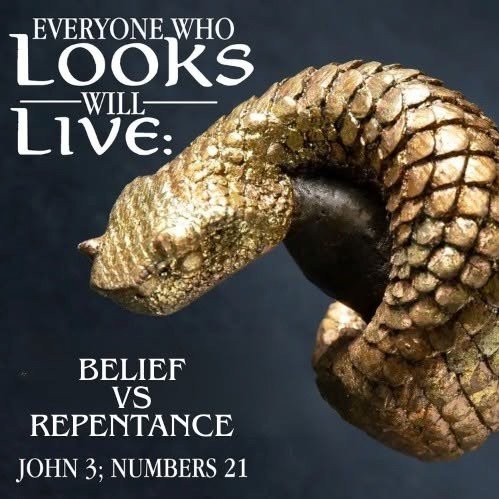
The story of the bronze serpent in the Bible, found in Numbers 21 and referenced by Jesus in John 3, isn’t primarily about repentance. Instead, it’s a powerful illustration of the simple act of belief.
Many people, when they first encounter this story, might assume it’s about feeling sorry for your sins and changing your ways. After all, the Israelites were complaining against God and Moses, and they were punished with deadly snake bites. It seems like a classic setup for a call to repentance.
However, a closer look at both the Old Testament account and Jesus’s own words reveals a different emphasis entirely. The core message is surprisingly straightforward: look and live.
The Original Story: Look and Live
In Numbers 21, the Israelites are in the desert, complaining about their harsh journey and lack of food. God sends poisonous snakes among them, and many die. When the people cry out to Moses, God tells him to make a bronze serpent and put it on a pole. The instruction is clear:
“Everyone who is bitten, when he looks at it, shall live.”
Numbers 21:8, NKJV
Notice what isn’t mentioned here. There’s no talk of extended confession, deep sorrow for their complaining, or a promise to change their behavior. The healing isn’t conditional on a lengthy process of introspection or a vow to be better people. It’s a direct, immediate action: look at the serpent, and you will be healed.
This isn’t to say their complaining wasn’t wrong. Of course it was. But the solution offered by God didn’t involve a complex ritual of repentance. It was a simple, observable act of trusting God’s provision through the serpent.
Jesus and the Bronze Serpent in John 3
Centuries later, Jesus uses this very story when talking to Nicodemus, a religious leader. In John 3:14–15, Jesus says:
“And as Moses lifted up the serpent in the wilderness, even so must the Son of Man be lifted up, that whoever believes in Him should not perish but have eternal life.”
John 3:14–15, NKJV
Here, Jesus draws a direct parallel. Just as the Israelites looked at the bronze serpent to be saved from physical death, people must look to Him, the Son of Man, to be saved from spiritual death and receive eternal life. The critical word Jesus uses is “believes.” He doesn’t say, “whoever repents,” or “whoever surrenders,” or “whoever goes through a long period of moral transformation.”
The entire conversation in John 3, from verses 14 through 18, repeatedly emphasizes belief in Jesus as the key: “For God so loved the world that He gave His only begotten Son, that whoever believes in Him should not perish but have everlasting life” (John 3:16, NKJV). The focus is squarely on trusting in Jesus.
Belief Versus Repentance: A Crucial Distinction
Some prominent Bible teachers, like Dr. John MacArthur, interpret Jesus’s words to Nicodemus, and the bronze serpent analogy, as primarily about repentance. They might argue that true belief inherently includes repentance. However, Jesus Himself does not use the word “repent” in His dialogue with Nicodemus.
While repentance—turning away from sin—is undoubtedly an important part of a Christian life, and often accompanies belief, it’s not the explicit condition Jesus states here. To equate “belief” with a full process of “repentance” can add requirements that aren’t present in the text. It risks making salvation seem more complicated than Jesus presented it in this moment.
The bronze serpent story, as explained by Jesus, highlights the simplicity of God’s offer. Just as a dying Israelite only needed to look, we only need to believe. It’s about placing our trust in what God has provided, not about earning our way through our own efforts or a specific emotional state of regret.
Ultimately, the story of the bronze serpent serves as a powerful reminder that God’s plan for salvation, as revealed through Jesus, is profoundly simple. It calls for a direct, trustful gaze towards the One who was lifted up for us. It’s about belief, pure and profound, offering life to all who look.
Part of the series: Responding to Lordship Salvation (all six articles in reading order). Watch the teaching: Faith at Repentance: Pareho Lang Ba o Magkaiba? on YouTube. Related reading: The Lordship Salvation Discussion and The Distinction Between Justification and Sanctification.