Tag: Faith Alone

topic

  • Interpreting the Woman at the Well (John 4)

    Interpreting the Woman at the Well (John 4)

    Few passages in John’s Gospel are as rich as the story of the woman at the well. Yet few are as often misread. Jesus meets a Samaritan woman at Jacob’s well and offers her “living water.” Many have pressed this text into service for their own doctrinal agendas. For example, one of the more influential misreadings comes from John MacArthur. His treatment of the living water deserves careful scrutiny.

    MacArthur’s Reading of John 4

    MacArthur reads Jesus’ offer of living water as a call to full surrender. In his view, Jesus demands total submission and compliance as the condition for receiving the gift. In fact, this reading fits his broader Lordship Salvation framework. There, saving faith cannot be separated from an ongoing surrender of one’s whole life to Christ’s lordship.

    Of course, surrender to Christ is important. The problem is that John 4 is not about it. Look closely at the narrative flow of the passage. Nothing in the text makes the gift of living water depend on her willingness to submit. MacArthur brings that theological category to the passage from outside. In other words, he does not draw it out of the text.

    Eisegesis versus Exegesis

    This distinction matters enormously, and it has a name: the difference between eisegesis and exegesis.

    • Exegesis draws meaning out of the text. It reads the passage in its own context. It traces its own logic and lets its own words and story shape what it teaches.
    • Eisegesis reads meaning into the text. It starts with a fixed theological conclusion and then makes the passage support it.

    MacArthur’s treatment of John 4 works eisegetically. He does not derive “surrender and compliance” from the conversation between Jesus and the woman. Instead, he imports it from a prior belief about the nature of saving faith. Then he reads the “living water” metaphor through that lens. As a result, the Gospel story becomes a backdrop for his doctrine rather than its source.

    Sound interpretation works the other way around. The narrative itself must establish what “living water” means. That includes its details, its cross-references, and its stated outcomes.

    What the Text Actually Shows

    So what does John 4 itself indicate?

    The outcome of the encounter is belief, not behavioral transformation. After talking with Jesus, the woman returns to her village. However, she does not describe a moment of surrender. She testifies about who Jesus is. Then the narrative tells us the result. Many Samaritans believed in Him because of her word. Many more believed because of His own word (John 4:39–42). In short, the climax of the passage is about faith. They believe that Jesus is the Messiah, the Savior of the world. Suppose John meant “living water” to signal surrender and compliance. We would then expect the story to end with changed behavior or submission. Instead, it ends with belief.

    John’s own vocabulary links “never thirsting” with believing. Just two chapters later, Jesus says, “He who comes to Me shall never hunger, and he who believes in Me shall never thirst” (John 6:35, NKJV). Here coming and believing are parallel acts. “Never thirsting” belongs to belief, not to submission or surrender. John uses the same “thirst” language in both passages. So it is sound method to let John 6 explain John 4. Never thirsting is what happens when a person believes.

    The Correct Interpretation of “Living Water”

    Read on its own terms, John 4 teaches something simple. Read in light of John 6, it is even clearer. The living water Jesus offers is everlasting life, and He gives it to those who believe in Him. The woman at the well is not a model of total surrender. Rather, she is a model of simple faith. She hears who Jesus claims to be, and she believes.

    This is not a minor exegetical quibble. It goes to the heart of John’s stated purpose: “but these are written that you may believe that Jesus is the Christ, the Son of God, and that believing you may have life in His name” (John 20:31, NKJV). Clearly, John 4 fits that purpose precisely. It is a belief passage, not a surrender passage.

    Why This Matters

    When we read a text eisegetically, we can make it say almost anything a system needs. Exegesis is different. It asks what John’s narrative itself says. Next, it traces his vocabulary across chapters. Finally, it lets the outcome of the story shape our conclusions. Read this way, John 4 speaks with clarity. Jesus does not make His gift at the well depend on total surrender. A person receives it the moment he believes in Him.

    That is good news. Indeed, it is the very good news the Samaritan woman carried back to her village.

  • Belief, Not Repentance: The Bronze Serpent in John

    Belief, Not Repentance: The Bronze Serpent in John

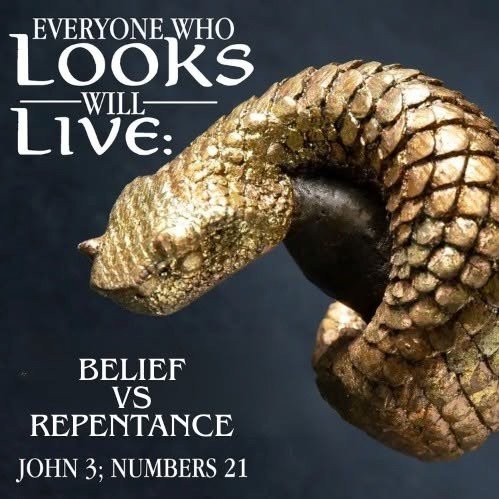
    The story of the bronze serpent in the Bible, found in Numbers 21 and referenced by Jesus in John 3, isn’t primarily about repentance. Instead, it’s a powerful illustration of the simple act of belief.

    Many people, when they first encounter this story, might assume it’s about feeling sorry for your sins and changing your ways. After all, the Israelites were complaining against God and Moses, and they were punished with deadly snake bites. It seems like a classic setup for a call to repentance.

    However, a closer look at both the Old Testament account and Jesus’s own words reveals a different emphasis entirely. The core message is surprisingly straightforward: look and live.

    The Original Story: Look and Live

    In Numbers 21, the Israelites are in the desert, complaining about their harsh journey and lack of food. God sends poisonous snakes among them, and many die. When the people cry out to Moses, God tells him to make a bronze serpent and put it on a pole. The instruction is clear:

    Notice what isn’t mentioned here. There’s no talk of extended confession, deep sorrow for their complaining, or a promise to change their behavior. The healing isn’t conditional on a lengthy process of introspection or a vow to be better people. It’s a direct, immediate action: look at the serpent, and you will be healed.

    This isn’t to say their complaining wasn’t wrong. Of course it was. But the solution offered by God didn’t involve a complex ritual of repentance. It was a simple, observable act of trusting God’s provision through the serpent.

    Jesus and the Bronze Serpent in John 3

    Centuries later, Jesus uses this very story when talking to Nicodemus, a religious leader. In John 3:14–15, Jesus says:

    Here, Jesus draws a direct parallel. Just as the Israelites looked at the bronze serpent to be saved from physical death, people must look to Him, the Son of Man, to be saved from spiritual death and receive eternal life. The critical word Jesus uses is “believes.” He doesn’t say, “whoever repents,” or “whoever surrenders,” or “whoever goes through a long period of moral transformation.”

    The entire conversation in John 3, from verses 14 through 18, repeatedly emphasizes belief in Jesus as the key: “For God so loved the world that He gave His only begotten Son, that whoever believes in Him should not perish but have everlasting life” (John 3:16, NKJV). The focus is squarely on trusting in Jesus.

    Belief Versus Repentance: A Crucial Distinction

    Some prominent Bible teachers, like Dr. John MacArthur, interpret Jesus’s words to Nicodemus, and the bronze serpent analogy, as primarily about repentance. They might argue that true belief inherently includes repentance. However, Jesus Himself does not use the word “repent” in His dialogue with Nicodemus.

    While repentance—turning away from sin—is undoubtedly an important part of a Christian life, and often accompanies belief, it’s not the explicit condition Jesus states here. To equate “belief” with a full process of “repentance” can add requirements that aren’t present in the text. It risks making salvation seem more complicated than Jesus presented it in this moment.

    The bronze serpent story, as explained by Jesus, highlights the simplicity of God’s offer. Just as a dying Israelite only needed to look, we only need to believe. It’s about placing our trust in what God has provided, not about earning our way through our own efforts or a specific emotional state of regret.

    Ultimately, the story of the bronze serpent serves as a powerful reminder that God’s plan for salvation, as revealed through Jesus, is profoundly simple. It calls for a direct, trustful gaze towards the One who was lifted up for us. It’s about belief, pure and profound, offering life to all who look.

  • The Lordship Salvation Discussion

    The Lordship Salvation Discussion

    The Lordship Salvation discussion, which figures like Dr. John MacArthur champion, proposes a specific understanding of what it means to be saved. This view argues that true belief in Jesus Christ isn’t just a mental agreement. It also demands a committed, lifelong submission to Him as Lord. In essence, salvation isn’t complete without this ongoing obedience, framing the relationship as a master-slave dynamic.

    This perspective carries significant implications for anyone seeking eternal life. It suggests that if your life doesn’t show continuous submission, your initial “faith” might not have been genuine. This can lead to deep uncertainty and self-doubt for believers. They constantly question the validity of their salvation based on their performance.

    However, an alternative view strongly emphasizes that belief alone is the condition for eternal life. This position distinguishes the act of becoming a Christian from the journey of living as a Christian. Confusing the two complicates the clear message of the Gospel. It’s a critical distinction that impacts how we understand God’s grace and our role in receiving it.

    Defining Lordship Salvation

    Dr. MacArthur’s interpretation of Lordship Salvation asserts that genuine faith inherently includes submitting to Jesus’ lordship. This isn’t an optional add-on; MacArthur presents it as an inseparable part of true belief. The idea is that if you truly believe, you will naturally commit to a lifelong, slave-like relationship with Christ, characterized by obedience and submission.

    This perspective implies that if a person’s life doesn’t demonstrate this ongoing submission, their initial claim of faith might be false. It sets a high bar, suggesting that a lack of consistent obedience could mean one was never truly saved to begin with. This conflates the act of being justified (declared righteous by God) with the ongoing process of discipleship (following Christ daily).

    But the Bible repeatedly uses the language of simply “believing” as the decisive condition for eternal life. Passages often state that those who believe in Christ have everlasting life. They add no conditions of prior submission or a perfect track record of obedience. Scripture presents this simple act of faith, not a subsequent lifestyle, as the gateway to salvation.

    Understanding Doulos and Kurios

    The terms doulos and kurios are Greek words central to this discussion; translators often render them “slave” and “lord” or “master.” Proponents of Lordship Salvation use these terms to reinforce the idea of a master-slave relationship between Christ and the believer, implying that a “slave” must always obey their “master.”

    While the lexical meanings of these words are accurate, the theological inference drawn from them is debatable. Many interpreters rightly see being a “slave of Christ” in the biblical context as an honored or exalted position, not a negative one. It signifies devotion and service, a chosen commitment rather than a forced penalty. Consider Paul, who frequently identified himself as a doulos of Christ; this was a title of honor and purpose, not a burden on his salvation.

    The issue isn’t the terms themselves, but the implication that this “slave-like” obedience is a prerequisite for receiving eternal life. This misinterprets the nature of grace, which offers salvation freely through faith, not through works or a specific level of submission.

    Faith as the Sole Condition for Salvation

    Scripture consistently emphasizes belief as the sole condition for receiving eternal life. Numerous verses state that whoever believes in Christ has everlasting life and is justified. For example, John 3:16 is a foundational verse:

    There are no added conditions about a perfect lifestyle or absolute submission before belief.

    Lewis Sperry Chafer, a prominent theologian, reinforced this point, highlighting the prevalence of “belief-language” in the Bible as the decisive factor for salvation. The act of placing one’s trust in Christ is what grants eternal life, not a subsequent demonstration of discipleship. This is a critical distinction, separating the moment of salvation from the lifelong journey of following Christ.

    Therefore, the proper biblical category for entry into eternal life is simply faith. It’s a trust in Christ’s finished work on the cross, not a promise of perfect obedience or a track record of submission. God offers His grace freely, and we receive it through belief.

    Discipleship Versus Justification

    It’s crucial to separate discipleship from justification. Justification is the divine act where God declares a believing sinner righteous based on Christ’s sacrifice. It’s a one-time event, received through faith alone.

    Discipleship, on the other hand, is the ongoing process of following Christ, growing in obedience, and committing to His teachings. It’s a lifelong journey that happens after salvation.

    Serving Christ as a “slave” or servant is a natural outcome of discipleship, a moral posture that those who are already saved adopt. It is not the basis for being declared righteous. Conflating these two concepts can lead to a works-based salvation, similar to Roman Catholic theology, where good works become a condition for earning or maintaining salvation.

    The Bible is clear: faith is the operative requirement for eternal life. Discipleship is the beautiful, challenging, and necessary response to that salvation, but it is not its foundation. One receives eternal life by believing, and then, as a saved person, commits to following and serving Christ.